The Wheego Whip LiFe: 90 miles on a charge. (Credit: Jim Motavalli)
ATLANTA--We've reached the make-or-break point for electric vehicles. As many as a half dozen different models will be on the road by the end of the year, and when it comes right down to it we have no idea if people will line up to buy them.
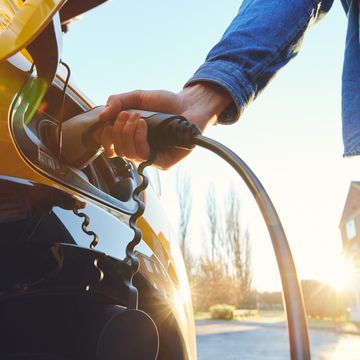
There are several big hurdles, including price (EVs will be significantly more expensive than we're used to -- small two-seat cars will start around $25,000), unfamiliarity (people will be plugging in at night, instead of going to the gas station) and range anxiety (most of these cars will go only 100 miles between charges).
Last week, I talked to Mary Ann Wright, managing director of the business accelerator at major battery maker Johnson Controls (they're supplying lithium-ion packs to both the BMW and Mercedes-Benz hybrids), and heard about the "EV gap." She said the industry worldwide has the capacity to produce four million cars, but the actual demand might be only two million.
Wright was among several witnesses at a Senate hearing last week asking the feds, specifically the Department of Energy, for help closing that gap -- with one popular concept being the mass purchase of EVs for government fleets, which could include more than a million vehicles. It makes a lot of sense, particularly because fleet cars come back to central depots that make recharging a cinch.
Wright also told me that EV costs will come down with desperately needed volume. "Scale won't get us all the way, but it is going to be a significant driver," she said.
I thought about all this in Atlanta, where I had the opportunity to be the first journalist to drive the Wheego Whip LiFe, an unusual name for a tiny, Smart-like two-seat battery EV with a 90-mile range and the need for an overnight charge. The LiFe, built by a small company (really small, I'm talking five employees) whose previous entries were neighborhood vehicles incapable of highway travel, could be on the road as early as June. That would make it probably the second EV on the road after the Tesla Roadster -- and, at $32,000 (before a federal $7,500 income tax rebate), the first EV intended for a mass audience. The Wheego was great fun to drive, reasonably fast, offered exceptional handling and a tight turning circle, and was unearthly quiet. Here's a closeup look on video:
Mike McQuary is a brash serial entrepreneur who built the Mindspring ISP into a major force (before merging it with EarthLink), and now heads Wheego (as well as a record company, Brash Music). He says he'll be happy with sales of only about 2,000 in the first year. EVs are an unknown in the marketplace he says. With luck, his car will survive crash testing and he'll have 50 dealers in place by the summer. But will people plunk down what is effectively $26,000 (after the rebate) when, say, a Toyota Yaris offers familiarity and four seats for $13,000?
The cost of operating an EV is considerably less than a gas car, a few cents a mile compared to 25 to 40 cents. And we shouldn't "mis-under-estimate" (I just heard Simon Cowell say that) people's willingness to do the right thing when it comes to the environment, because EVs are as green as they come. Even when the electricity comes from coal plants, they're far kinder to the planet than even a fuel-efficient gas car.
Cars like the Wheego are cute, too, and people like being early adopters of earth-friendly technology. Perhaps it will surprise everyone and become a green fad car. The Smart was definitely that, but unfortunately it didn't last. The Mini (being tested in EV guise as the Mini-E) is showing more staying power.
"The more I researched electric vehicles, the more I was convinced that they would have a comeback and become a lasting part of the transportation industry," said McQuary. "When you look at where we were 15 years ago with cars like the EV-1, it's plain the technology has improved. We have battery breakthroughs, better onboard chargers, smarter hardware overall. At the same time, we've had a huge movement toward environmental consciousness, driven by Al Gore's An Inconvenient Truth. People are more aware of the global consequences of climate change, and are willing to do something about it."
Luckily, doing something about it might just include buying a Wheego Whip LiFe, a Chevrolet Volt, a Coda sedan, a Fisker Karma or a Nissan Leaf. Carlos Ghosn, CEO of Nissan, is in Geneva tonight, and he's optimistic. "The numbers are big," he said. "I think there's going to be a need for new capacity... We may have to rush to build capacity for cars and batteries." Of course, he also said his Nissan Leaf was going to be "the only one on the market" in 2011, and he might have some argument there.
Friend us on Facebook and Follow us on Twitter
Follow Jim Motavalli on Twitter
|
||||||||||||
![]() |
Enter your city or zip code to get your local temperature and air quality and find local green food and recycling resources near you.
|
![]() |
||||||||||
![]() |
||||||||||||