

Monday, December 1
ADVERTISEMENT
NEW GREEN CUISINE

4.3.2008 9:09 AM

Is Farmed Fish Not All Bad?

Kona Blue Raises Its Fish With Sustainability in Mind.

e-mail
print
rss
widget
Kona Blue Water Farms.
Photo: Kona Blue Water Farms

By Annie Bell Muzaurieta

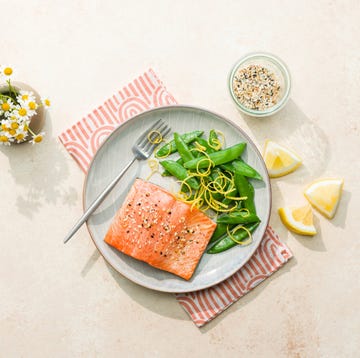
Kona Kampachi is a buttery and rich-tasting fish. It’s versatile and readily available. But it’s also farmed.

Kona Kampachi is produced by Kona Blue. The company, located in Kona, Hawaii, proudly boasts of the health benefits of its fish, which are monitored from hatch to harvest, and of its sustainability initiatives.

Sustainable farmed fish? Isn’t that an oxymoron?

Maybe not. Kelly Coleman, VP of marketing for Kona Blue, says that because the fish swim in 200-feet deep waters with strong currents, the area doesn’t become overpolluted with fish waste, which is a frequent complaint of farmed fisheries closer to shore.

Kona Blue has to frequently test the waters around the cage that contains the fish as part of their agreement with Hawaii. Coleman says they have found no difference in the water quality upstream and downstream.

To keep the gene pool fresh, they occasionally catch wild fish – 300 over 7 years – which, she says, isn’t contributing to depletion. In addition, Kona Kampachi has no detectable mercury.

But what about the fish food?

Farmed fish feed is made of wild fish; It can take three times as much wild fish to feed a farmed fish, which is not a sustainable model.

Kona Kampachi eat pellets composed partly of Peruvian anchovies, which are a sustainable and well-managed fish, according to Coleman, as well as corn gluten. And they’re improving the recipe. “Last year the company switched to a formula of 50% fish meal, 50% grain, and we need to get it down even further. To get it to a 1 to 1 ratio is our goal. We got as far as we can get using grains, but we have a new formulation, which is 25% fish meal and fish oil, and 75% grains and poultry meal.”

The Environmental Defense Fund, whose scientists have worked with Kona Kampachi’s scientists, released a statement about Kona Blue’s decision to use poultry byproducts.

Dr. Rebecca Goldburg, senior scientist for Environmental Defense, said, “Kona Blue’s decision to source poultry processing byproducts for their fish feed helps to protect marine ecosystems because Kona will substitute poultry byproducts for feed ingredients made from wild caught fish. Kona Blue’s use of poultry byproducts helps to satisfy the protein requirements of their fish, while significantly reducing the company’s use of finite ocean resources.”

Dan Barber, champion of the farm-to-table movement, serves Kona Kampachi at his Blue Hill restaurant in New York City, and says we have to consider sustainable alternatives. Regarding the Kona Kampachi pellets, he says, “I have question marks, but my bigger question mark is what are we going to do about eating fish?”

Barber says people sometimes ask him how serving Kona Kampachi works with his message of eating locally. “If restaurants were only supporting Northeast fisheries, they wouldn’t be serving very much because of the state of Northeast fisheries,” he said.

He explains that we’ve got to consider companies such as Kona Blue who are at least taking steps in the right direction: “The best ecological practices lead to the best flavor.”

You can learn more about Kona Kampachi on Kona Blue’s website. The Environmental Defense Fund offers information about eco-friendly seafood choices on their website, available for mobile phones too.


e-mail
print
rss
widget

Comments  |  Add a comment

so far..
loading.. please wait
ADVERTISEMENT

Win One of Three Eco-Trucks from Sprig Toys!
Easy Steps to a Greener, Healthier Diet
Find Out The Truth Behind Organic Food Labels
The Top 12 Foods You Should Eat Organic
5 Ways to Save on Organics
Search for a location:
Enter your city or zip code to get your local temperature and air quality and find local green food and recycling resources near you.

ADVERTISEMENT
Hearst Digital Media