It's time for the last mad rush to preserve the bounty of the harvest season. Such a project is not the preserve (forgive the pun) of the Martha Stewart crowd. It doesn't require perfectionism or even much skill, just patience and time. Canning is where you can save money eating organic, local food. Pick one fruit or vegetable and go for it -- buy 25 pounds per adult or teen (to serve throughout the winter). You'll likely get a deal on that quantity if you're buying it from the farmer. And let the food guide you; it'll be cheapest when it's the peak of its season. Tomatoes are a nice thing to do right now, or pears or apples. Quinces and gooseberries, old-fashioned favorites, will be going strong a while yet; and in cooler climates you'll still find blueberries or blackberries.
Canning your own food is a good way to maintain peak nutrition. Unlike supermarket canned goods, you'll be using grade-A produce picked when it's ripe. "It's not just about the vitamins and minerals found inherently in fruits and vegetables, it also includes all of the phytochemicals and really powerful disease-fighting substances that need to be considered. And we do know that when a food doesn't get the chance to reach its peak of ripeness, the levels of these substances never get as high." says Cynthia Sass, a Tampa-based spokesperson for the American Dietetics Association. She recommends that people eat a rainbow of home-preserved foods for maximum winter health.
The best basic resources for canning and preserving are all-round cookbooks such as The Good Housekeeping Cookbook, Joy of Cooking, or Fanny Farmer. For online resources, I recommend: National Center for Home Food Preservation and Backwoods Home Magazine.
Following are some of the more common canning questions I've been asked that I'd like to share with you:
Let's Get Started
Canning Equipment:
8 cups pitted plums 2 2/3 cups honey
1. To pit plums, cut in half and pull out pit. Place plums in large pot on very lowest heat until plums release liquid (perhaps half an hour), then raise heat to medium, watching carefully and stirring with wooden spoon. Once plums reach a vigorous boil, begin to gradually lower heat to maintain a low boil (just bubbling). Continue to stir every 15 minutes or so to keep fruit from sticking to bottom of pan. If froth forms on surface of liquid, skim it off. (And eat as dessert with ice cream!)
2. Meanwhile, put small Mason jars (perhaps 8 half-pints will be needed) on wire racks in large pot, with tops covered by an inch of water, and bring to boil. Ensure water boils at least five minutes from the time the water comes back up to a boil to sterilize. Boil ladle as well. Boil lids in a separate, smaller pot.
3. When jam has thickened after a few hours - test by putting a drip of liquid on a plate; it should no longer be runny when cooled. Ladle into jars, leaving about a 1/2-inch of headspace free to lip of jar. If there is liquid on top edge or outside of jar, wipe off with clean dampened cloth. Place lid on and tighten moderately. Jars are sealed when lid makes a popping sound and when you press on the top, it won't move. If after a few hours jars don't seal, you can put them in warm water (with tops covered) on high heat, to boil for five minutes, counting from time water is bubbling vigorously.
General jam information:
Use approximately 1/3 cup of honey to each cup of fruit, adjusting up or down depending on how sweet or sour the fruit.
Beginner's note:
If you can still find berries at this time of year, start with those. No pits to remove! (Though you will have to remove stems from blueberries and currants ... hulls from gooseberries.) Is there a free ride? Yes, blackberries!
Other Fruit-Filled Concoctions To Make Now And Savor Later:
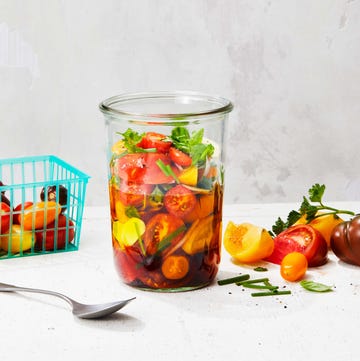
Canned Tomatoes and Juice
20 pounds of tomatoes
Approximately 8 teaspoons of salt (one per quart jar)
Note: At least 1/3 of all tomatoes will be needed to make juice to fill jars.
1. Boil water in stock pot, arrange tomatoes in large sieve (or wire tray) and dunk in hot water for about a minute, and then plunge immediately in cold water (a full sink's worth).
2. For whole tomatoes: Peel off skin. Pack into clean quart jars as close together as possible. Fill with tomato juice (see following) and add 1 teaspoon of salt per jar. Leave 1/4 inch of headspace free. Screw on lids medium-tight. Put on wire racks inside your large canning pot and bring to boil. Once water is boiling vigorously, count off 45 minutes until done then remove jars with lifter or tongs.
3. Tomato juice: Wash, core, and cut tomatoes into eighths. Simmer them in covered pot until just soft. Don't boil them. Immediately press through sieve to remove skins and seeds, which you will not use. If there is extra juice left over, you can fill jars with it (also adding 1 teaspoon of salt per jar) and boil these for 30 minutes.
|
||||||||||||
![]() |
Enter your city or zip code to get your local temperature and air quality and find local green food and recycling resources near you.
|
![]() |
||||||||||
![]() |
||||||||||||