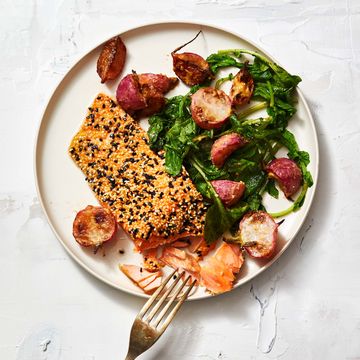
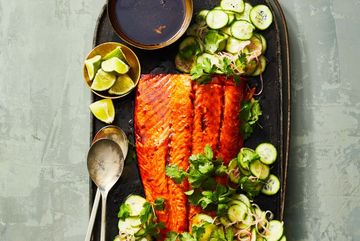
DAY 74 - The other day I took an important phone call at 8 a.m. It was Steve, the Organic Ocean fisherman from whom we buy most of our seafood, calling to say there had been a very short commercial fishery for sockeye salmon heading up the Fraser River. Would Alisa and I want a fish or two? I raced off to the docks and picked up the best sockeye Ive ever tastedI ate the first round raw as 100-mile sushi for lunch, then baked up dinner with no salt, no sauce, no nothing. Just the flavour of the salmon and that was more than enough.
But fish are complicated. The sockeye was caught off Pender Island, comfortably within our 100-mile circle, but they were heading home to spawn in the Chilko River, well outside our local area in a landscape a world apart. How do we define local seafood?
I took up that topic with Gigi Egan of Iron Maiden Seafoods (shes been fishing for 18 years and has put in more than her share of hours on various fisheries boards) at the farmers market a week later. We ended up talking about the world as it is versus the world as it might be, and where the locavore fits in between the two.
As Gigi explained, the world as it is makes the idea of local seafood complex. Suppose you live, like I do, in Vancouver. Wherever a fish or seafood is caught on the B.C. coast, it is likely to be processed or distributed (or both) out of Vancouver. A fish caught closer to Vancouver comes with fewer food miles, but the argument against eating fish from further afield in B.C. isnt all that strongthe fish are coming here no matter what. While much of that fishery is not local, it is at least regional, and reduces both demand for global fish on our shores and the amount of fish shipped from B.C. to Japan, Germany, etc. Then theres the population question. What if the two-million-odd people in the Vancouver area all decided to eat only seafood from within a 100-mile radius? Thats rightwed pretty quickly wipe out every living thing. In fact, population pressure has already done a lot of damage, which is why most of the fish we buy in Vancouver is coming from far away. Finally, the most efficient way (in terms of fuel and catch) to hook some migratory, deeper-water fish, like tuna, is to follow them up or down the coast, sticking with the fish before returning to port. Theyre almost never caught within 100 miles. Do we cross them off the list?
To me, all of these questions point to why a 100-mile diet can be such an interesting experiment. Eating locally pushes you to think about the questions that come up. Why does all the processing and distribution have to be centralized? How do we weigh the benefits of that centralization against the costs? (Our coast is littered with ghost towns and cannery rows from the era when much of the processing and distribution was local.) Does the current trend toward ever-bigger cities make sense, or do we need to keep our communities closer to the carrying capacities of the landscapes we live in? Shouldnt we be working harder to restore the local stocks that can no longer feed us? And what about more distant fish stocks? Is it even possible to fish them sustainably? (Im reminded of the fact that the East Coast offshore fishing fleet was once powered entirely by sailthe legendary Bluenose was one of the boatsand that the sail fishers warned that power boats would spell the end of the stocks.)
Ultimately, though, I still havent answered the question, What is local seafood?
Gigi and I came to a kind of agreement. We both felt that people can learn a lot from a strict 100-mile diet experiment. The 100-mile diet makes people far more aware of where their seafood is coming from and under what conditions. It can make people care far more about the state of their local waters and local marine life. If the people of Vancouver had to depend on the Fraser River to feed us, we sure as hell wouldnt have let things get to the state theyre in now.
But the 100-mile diet is just that, an experiment. It can open our eyes to what has been and what might make sense in the future. For that reason, when Im on a 100-mile challenge (like right now), Ill only eat fish caught from within the circle. But when Im not on a 100-mile challenge, Im more flexible. Heres what I do:
- I try to get to know the people, like Steve and Gigi, who bring in the seafood I eat. I know their fishing practices, I know where the fish have come from, I know theyll answer any question I might have, and I know they care.
- I only buy seafoods that are rated a Best Choice (for sustainable harvest) by SeaChoice.*
- I prefer restaurants that are signed up with the Ocean Wise program.
- I prefer seafood species that are abundant and reproduce quickly, like shrimp and shellfish, and limit the number of big fish I eat (last year, Alisa and I ate one tuna between us, bought whole and butchered at home).
None of the fish that Alisa and I eat comes from all that far away. If it isnt strictly 100-mile, it at least comes from the local fleet when they tie up after their sojourns out at sea or up the coast. Biologically speaking, we live on one of the worlds richest shores. If the day ever comes that it cant feed us, then we, as a society, will have a lot of explaining to do.
*Gigi adds that she supports the concept of SeaChoice, but considers some of their fisheries data flawed, noting as an example that Oregon trawl shrimp is listed on the website as a best choice (and B.C. shrimp is not listed at all) despite the fact B.C. shrimp had a substantially lower by-catch and habitat impact. I do note, though, that the SeaChoice wallet card offered by Sustainable Seafood Canada (available on the website here) does give B.C. sidestripe shrimp the green light (though it erroneously describes them as trap caughtin fact, they are trawled). Simple, eh? To my mind, all the complications point back to my number one approach, listed above: get to know your food producer.
| so far.. |
|
|
||||||||||
![]() |
Enter your city or zip code to get your local temperature and air quality and find local green food and recycling resources near you.
|
![]() |
||||||||
![]() |
||||||||||