Tuesday, February 9
ADVERTISEMENT
GREEN HOMES
The Greengrower

Do You Need Organic Seeds for Organic Gardening?

Starting Off on the Right Foot or Unnecessary Expense?


At first glance, it seems like a no-brainer: If you're going to be an organic gardener, you ought to plant organic seeds. But it would really be better to say: if you're going to buy organic products, put organic seeds on your shopping list.

For home gardeners, the reason to choose organic seeds is to support organic agriculture. It has very little to do with the seeds themselves.

Why does this matter? Because it means you can organically grow whatever you want. From the garden's point of view, one bundle of genetic material is pretty much like another (assuming said bundle is good of its kind and has not been treated with fungicide or otherwise messed-with post harvest).* So although organic seed is preferable when available, insisting on its exclusive use is a little like removing your nose in order to spite your face.

In many cases, the organic version is available, especially if it's a common vegetable. But uncommon heirlooms are another story; vast numbers of interesting flowers have not yet been included, and the number of organically grown hybrids is still mighty petite.

I shall stand back now and wait for the anti-hybrid avalanche to roll by, hating hybrids being all the rage these days. Well, ok. Hybrid seeds cannot be saved from year to year; you have to keep buying new ones.** (Like many organic seeds, btw) hybrids are mostly produced by large corporations whose interest in sustainability is entirely market-driven, to the extent that it exists. But this doesn't make hybrids Darth Vader.

In fact, hybrids bred for disease resistance are an environmental plus when they help you use less biocide. Pesticides and fungicides approved for organic gardening are still a long way from benign.

And while it's true that a great many hybrids don't taste very good, flavor having been sacrificed for qualities like heavy cropping and long shelf life, it's also true that some of the tastiest vegetables in all creation are hybrid varieties: Sun Gold cherry tomatoes, Silver Queen corn, Confection winter squash - we just had some for dinner last night. It was terrific.

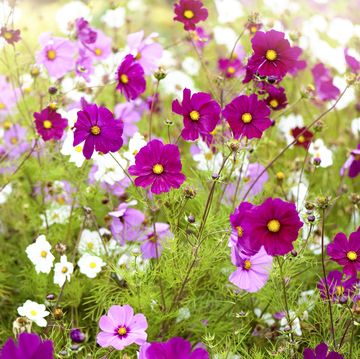
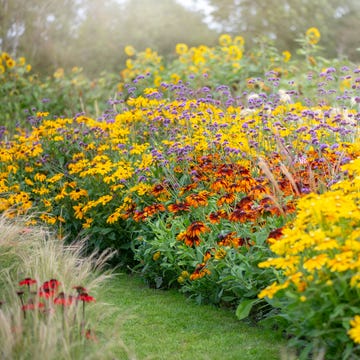
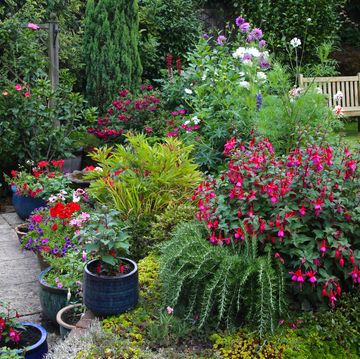
 Spring time view of Leslie Land's gorgeous garden.

Spring is just around the corner; time to get ordering.

For the full seed spectrum: open pollinated, hybrid, conventional and organic, try Johnny's Selected Seeds and Territorial Seed Company.

For a good-sized list (32) of companies that offer organic seeds, potato sets and garlic bulbs, go to ATTRA, the National Sustainable Agriculture Information Service.

* Seeds from plants that thrived under organic management should produce plants that fare better when grown organically in their turn, but as far as I know there has been no scientific trial of this thesis. It would probably take several generations before any differences were evident and my guess is that even then a grower's abilities - or lack thereof - would far outweigh any advantage conferred in the seed-production stage. Work is being done to create varieties tailored for organic production ( a very different thing), but this whole branch of plant breeding is still in its infancy.

** Actually, it is sometimes possible to "save" hybrid seeds, essentially by selecting and selecting and selecting again, over several generations of large grow-outs. It's called stabilizing a hybrid and it's a lot of work.

comment
tags:
Print RSS Share Facebook Twitter
Leslie Land

Leslie Land

Leslie Land writes about gardening, food and design for the New York Times and other outlets. She blogs at Leslieland.com.
read full bio.
buy the book

buy the book

1000 Gardening Questions & Answers: Based on the New York Times column "Garden Q&A"

Comments  |  Add a comment

so far..
loading.. please wait

ADVERTISEMENT
about this blog
Learn how to raise gorgeous green gardens and yards. read more.
recent posts most popular
archive

No-VOC Paints
7 Simple Money Savers for the Home
Surprising Sources of Indoor Air Pollution
Calculate Your Impact
Search for a location:
Enter your city or zip code to get your local temperature and air quality and find local green food and recycling resources near you.
ADVERTISEMENT
ADVERTISEMENT
Hearst Digital Media