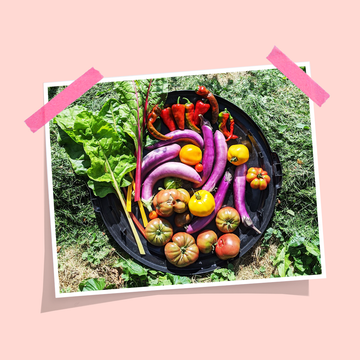
Are you seduced by curvy Golden Crescent beans? By Purple Dragon carrots, cushion shaped orange eggplants or yard long Red Noodle beans?

Welcome to the club. I've never been able to resist oddball vegetables; show me a shape or color that's different and bam, it goes on the order list.
This has been going on for 30 years and will no doubt continue for many more, but meanwhile some of these bizarro thrills have become staples in my garden -- and just as many have been consigned to the "interesting experiment" list.
STAPLES:
*Ronde de Nice zucchini, not the best for slicing but ace for stuffing.
Instead of the conventional canoe, you get a tidy little bowl that stays firmer in the oven and looks prettier on the plate. My favorite filling is caponata, topped with a thick layer of coarse breadcrumbs tossed with a little olive oil. Most delicious at room temperature.
* Yard long beans (Vigna unguiculata). You get a lot of bean with each bean, so they're quick to harvest and prepare. The taste is unique, sort of nutty and meaty instead of sweet and light like snap beans (Phaseolus vulgaris). They're not as crisp and juicy as snap beans, either, and are not helped by being lightly steamed. It takes thorough cooking to bring out their best.
Most published recipes are Chinese or Indian and involve several ingredients, but I usually just stir-fry them over medium high heat in olive oil or bacon fat until many brown spots appear.
Note: the red ones are great in flower arrangements and for the general wow effect, but they don't taste quite as good as the green ones, take longer to grow, and lose most of the color when cooked.
* Currant tomatoes, especially white currant. A labor of love. They're beyond easy to grow; plants are right next door to weeds and grow to huge size with no help from us. The labor part is harvesting. They're tiny ; each cluster ripens sequentially so they must be picked one by one and the calyxes tend to hang on, so if you're not careful the ripe fruit comes away with a hole in the top. Why bother? The love part. Beyond delicious. They are to full sized tomatoes as wild strawberries are to the cultivated kind.
* Yellow (Golden) beets. Everything that's tasty about beets, with no bleeding, and just as easy to grow if you don't count chronically lousy germination. More on beets anon; in the spirit of advocacy inspired by hearing that our new president hates them. No doubt he grew up on boiled and/or canned, and I'm sure that's got nothing to do with Hawaii though as I write the specter of pineapple raises its head ...

Where were we?
A FEW WILL DO
* Rat Tail Radishes are long, skinny seedpods, not roots, a godsend to anyone who has had trouble with root maggots, bolting or the numerous other ills that make me wonder why everyone says radishes are easy to grow. Nobody ever knows what they are, which is of course gratifying, and they're very tasty.
They grow in large bunches on gangly bushes about 3 feet tall that seem to withstand all pests and diseases. What's not to like? Two things:
1. Each pod is more or less wired to the main stem; unless you have iron fingernails every one must be individually cut from the plant.
2. The window of harvest is narrow. Picked too small, they're burning hot and tough; too large, they're hot, tough and unpleasantly strong flavored. Those that are heading toward large but not there yet are tasty stir-fried because cooking gentles them. And -- calling Goldilocks ! those that are just right are radishes: juicy and crisp and peppery, ideal radish substitutes.
* Crescent (Annelino) beans come in both green and yellow and are both tasty and handsome on the plate -- especially when presented as a tangle of mixed colors. Downside with these is the same as their raison de purchase: the uneven crescent shapes: you can't stack them, so they're laborious to trim. And because the sizes tend to vary you have to sort them into little piles and add them to the pan in batches if you want them to cook evenly.
DIDN'T WORK OUT (we've tried all these at least twice, just to be sure, except for the litchi tomatoes.)
Orange eggplants: As catalogs now have begun to admit the orange stage is fully mature, aka inedible. You eat them when they're green and there are plenty of other eggplants -- green, purple, lavender and white -- that taste and yield better.
Purple, yellow and white carrots: Have to confess I gave up on all these before the latest round of new introductions. None tasted anywhere nearly as good as the best orange carrots and the purple ones were especially frustrating: the flavor was unpleasant raw but the intense color was lost in cooking.

Cylindrical beets -- or at least Forono and Cylindra: Seems like such a good idea, a beet that gives even slices from end to end. And they lift their shoulders way out of the ground so they're almost worth it just for the dirty joke factor. Unfortunately the ones we grew were never as sweet and flavorful as the rainbow of round varieties, red, orange, white and candy striped that produce well every year.
Litchi tomatoes (Solanum sisymbriifolium): Like a lot of exotic solanums they grew easily into large bushes -- bigger in New York than Maine but plenty big there, too. The plants are quite fabulously thorny: stems, branches, leaves, fruit calyxes ... even the tiny seedling leaves have prickles stiff enough to hurt if accidentally pressed, so every stage of care and harvest was literally a pain. And when the fruit was finally fully ripe, phooey. Thick skinned, bland and almost fleshless; filled with hard little seeds. Maybe back home in South America, but not in the Northeast... where I have no doubt they'd have self-sown like bandits if not promptly uprooted.
| so far.. |
|
|
||||||||||
![]() |
Enter your city or zip code to get your local temperature and air quality and find local green food and recycling resources near you.
|
![]() |
||||||||
![]() |
||||||||||