11.4.2009 2:08PM
| permalink
Make a yummy salve for chapped lips with honey and olive oil (hey it's better than ear wax, right?). Or make a mild disinfectant with salt. Got a headache? Skip the giant pills and reach for vitamin C.
These are some of the suggestions from TDG Zen Cleaner blogger Michael de Jong, who has just released his latest book, Clean Cures: The Humble Art of Zen-Curing Yourself. Watch de Jong show you exactly how to concoct this natural remedies on this recent segent on Good Morning America Health.
Clean Cures has hundreds of remedy recipes, which de Jong hopes will help you protect the planet as well as your health and pocketbook. Not only can you avoid toxic chemicals and strong medicines, but you also can dispense with considerable amounts of packaging. For example, with his natural salve, you too can get kissable lips but without having to throw away all those empty tubes. de Jong worked with a physician during his research, and personally uses what he recommends (though of course no book should be considered a substitute for seeing a licensed doctor).
Want better skin and fewer trips to the pharmacy...all with natural ingredients you probably already have in your house? Visit Michael de Jong's website.
-Written by Brian Clark Howard
Posted By: Michael de Jong
10.7.2009 10:51AM
| permalink
It had to happen sooner or later, and sure enough here they are, catchily called Ecotulips.
As usual with newly introduced organic versions of things, there still isn't much selection and prices are a bit higher than for the conventional kind, but if you'd like to buy certified organic tulip bulbs, lovingly grown in Holland by an experienced bulb farmer, at least you've got the option.
So if the title is Organic Tulips, why is the first picture of a narcissus (poeticus narcissus, probably 'Pheasant's Eye')? Partly because I've already gone into how to grow tulips, and partly because there's more to environmental responsibility than simply buying organic and calling it a day.
For one thing, there's the mileage question; it's much easier to find (sort-of) locally grown daffodils than locally grown tulips.
For another, daffodils are much easier to save and reuse. Tulips can come back more frequently than they're given credit for, but they don't come back the way daffodils do and they certainly don't multiply the way daffodils do.
Also: deer. They eat tulips; they don't eat daffodils.
Choosing daffodils
This particular bunch is 'Obdam,' which I got some years ago from Brent and Becky's.
It's even harder than choosing tulips, but checking the description for "naturalize" eliminates a lot of otherwise tempting contenders. Naturalize is narcissusspeak for "likely to come back and multiply" and its omission is a warning that the beauty in question may not be an eager grower.
The other thing to keep in mind is use in the landscape.
Posted By: Leslie Land
9.22.2009 3:38PM
| permalink
As you've no doubt noticed if you follow these things, the current fashion in bouquets has oneness at its heart. Either it's one kind of flower -- roses, say or gerbera daisies -- or it's one color: white or pink or (in the higher rent districts) green.
Not usually purple, it must be admitted, but otherwise this is typical, or typical of one colorness, anyway.
Gladioli and sweet peas are not typically buddies but this has been a weird summer.
This year, the kind of bouquets my old friend Sharon calls "It must be August," only became possible in early September. Most of the good annual cutting flowers take time to start producing in earnest, and that goes double for the ones you get by letting things like Verbena bonariensis and nigella self-sow.
Posted By: Leslie Land
8.23.2009 7:10PM
| permalink
It's a major challenge, all right, but after losing all the tomatoes in New York, we're trying to see if at least one of the Maine tomato patches can fight off late blight (Phytopthera infestans), one of the most devastating vegetable diseases. It's the one that led to the Irish potato famine and it's just as deadly almost two centuries later.
P. infestans is always around, but it came early this year, and more ferociously than ever before. Farmers and home gardeners from Maine to South Carolina -- and quite a way west -- have already lost their crops to what has turned out to be the most widespread outbreak in U.S. history.
If you see any signs of late blight, experts advise destroying all infected plants at once, to stop the spread of spores. And if you live in an area where there are gardens or farms that have not yet been hit that is the advice to take; late blight is highly contagious. But if everyone else already has it and yours is the garden that's hanging in, you might as well join us in employing:
The Organic Gardener's Arsenal:
- Fungicide
- Fertilizer
- Being There
- Being Careful
- Being Realistic
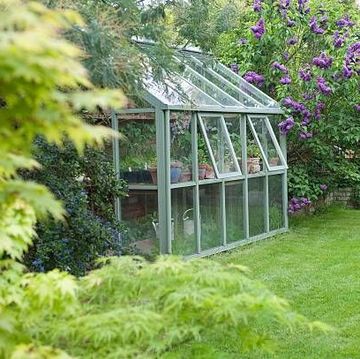
And -- at least in our case -- Being a Procrastinator. If I'd done all the tomato grafting I'd planned to do, there wouldn't have been any leftovers in the greenhouse. Luckily, the tomato plants in the greenhouse (pictured) have so far escaped the blight.
* The Fungicide we're using is Serenade, available at well stocked garden centers or online at suppliers like Peaceful Valley Farm Supply. It's approved for organic gardening and is a fairly effective prophylactic as long as it's applied frequently. Late blight can't be cured, and if it's well established it can't be stopped. But if it hasn't yet taken hold it can be held at bay by Bacillus subtilis, the "good" bacteria that is Serenade's active ingredient.
Posted By: Leslie Land
7.17.2009 12:02PM
| permalink
As far as I'm concerned, garlic gets the blue ribbon for growing your own. It's absurdly easy to plant and care for; it tastes great; it looks beautiful and it takes up so little ground that even those with very small gardens can raise enough to be self-sufficient in garlic for a good part of the year.
All you have to do is choose the right varieties; plant at the right time, in the right soil; then harvest when just right and store correctly.
Homegrown garlic, fresh out of the ground.
Choosing Varieties of Garlic
If you look in a specialist catalog like the one at Gourmet Garlic Gardens, you'll find dozens of choices. The folks at Filaree Farm, who offer a hundred, divide them into seven groups: Rocambole, Purple Stripe, Porcelain, Artichoke, Silverskin, Asiatic Turban and Creole. Gourmet GG says it's 10 groups because they divide Asiatic from Turban and add Marbled Purple Stripe and Glazed Purple Stripe to the list.
You see where this is going -- and you can see a lot more on either of those websites, but for general purposes the most important difference is the one between softneck and hardneck.
Softnecks are so called because the whole green plant dies down to pliancy, leaving nothing but the bulb and flexible stems that are easy to braid. Hardnecks have a stiff stem in the center that terminates in a beautiful flower -- or cluster of little bulbs -- then dries to a rigid stick that makes braiding impossible.
Softnecks, the standard garlics of commerce, are the easiest to grow in regions where the weather is mild. They keep longer than hardnecks, but they are less hardy and more prone to make small, very strong-flavored cloves. Hardnecks do best where there is a real winter and are more vulnerable to splitting -- or simply refusing to produce -- when grown in warm climates.
Gardeners in most of the U.S. can try some of both. Southerners should probably stick to softnecks and northerners (that's us) to the hard ones, but microclimates matter. Specialty sellers will suggest best bets based on your climate and tastes, and of course it's wise to get some seed stock from your local farmers' market: whatever it is, it's growing where you are.
Garlic Planting and Care
Plant in mid fall, (@ October 10 in the Hudson Valley) in loose, very fertile soil that's as weed free as possible. Insert cloves root side down about 8 inches apart in all directions (if space is limited, you can squeeze by with 6), burying the tips about two inches down. Green shoots will come up; mulch around them with straw. Hard freeze will come and kill the shoots. Draw the mulch over the whole bed.
In spring, pull the mulch back when the new shoots emerge. Give them a shot of mixed fish emulsion and liquid seaweed. Keep them weeded. Water only if the soil is dry two or more inches down, being sure to avoid pouring water into the crowns of the plants.
Posted By: Leslie Land